

There is a fleeting, distinct moment in every interior architecture project that no camera will ever truly catch.
The Italian marble hasn’t arrived yet. The walls are still raw, chalky plaster. There are no hand-knotted rugs, no custom brass fixtures, no carefully curated art. Just a vast, empty concrete shell at My Home Nishada in Hyderabad, humming with sheer potential.
I often find myself standing alone in that quiet space, mapping out the invisible choreographies of daily life. I’m not visualizing furniture; I’m visualizing moments. Where will someone instinctively pause to kick off their shoes after a grueling day? Where will grandparents sit on a slow Sunday morning while kids play on the rug nearby? Where will dinner conversations naturally migrate long after the plates are cleared?
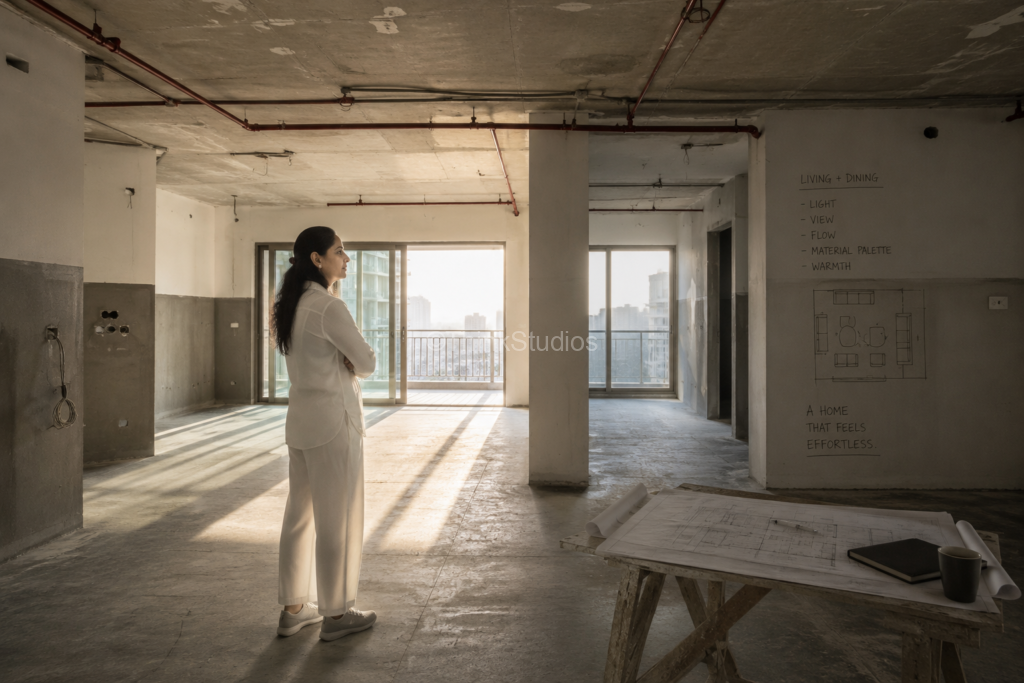
These human rituals rarely show up on a blue blueprint. Yet, they are the very lines that dictate the entire design.
Too often, people assume that luxury design is an exercise in accumulation—a shopping list of rare materials and eye-watering price tags. But exceptional spaces are never born from material wealth alone. They are realized through thousands of micro-decisions that quietly protect one another until a home feels completely effortless.
And that kind of effortlessness? It is meticulously engineered.
1. The Human Blueprint: Life Before Layouts
Every home tells a story. The real question is whether the designer has the patience to listen before picking up the pencil.
Our initial consultations with a family rarely begin with mood boards, timber swatches, or stone finishes. Instead, we talk about the cadence of their lives. We ask about their typical Sundays. Do they host grand, sweeping soirées, or do they prefer intimate, wine-filled dinners with close friends? Will the formal living area be an active part of their week, or is it a ceremonial space reserved for festive occasions? Do they read? Do they work from home?
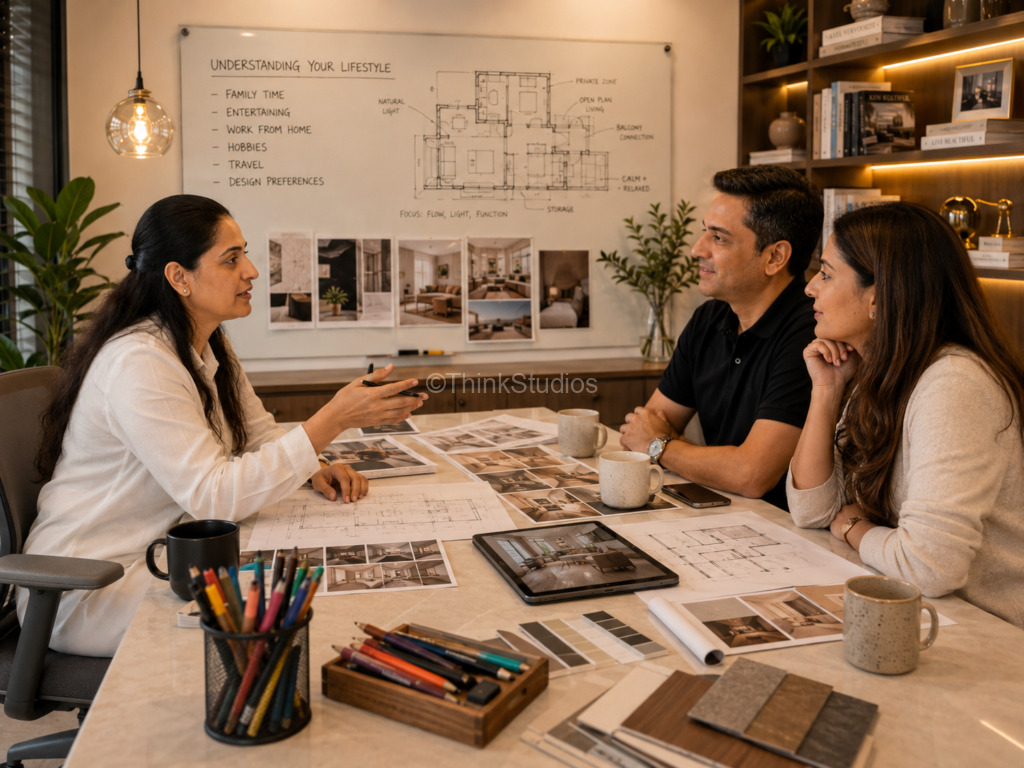
What these conversations reveal is a profound psychological truth: people don’t invest in larger square footage because they want more concrete. They buy it because they are craving a different, more elevated way of living. Our job is to translate that aspiration into spatial reality.
From My Site Notes
“Clients will eventually forget the exact layout dimensions of a room, but they will never forget how it made them feel during a conversation. Designing for atmosphere always outlasts designing for metrics.”
2. The Choreography of Movement
In high-end residential design, luxury is not a finish. Luxury is a journey. It’s about circulation, transition, and how a home reveals itself to you.
How do you cross the threshold? What does your eye instinctively seek out first? Does the apartment give everything away at the front door, or does it unfurl gradually, room by room?
For this 4,600-square-foot residence, we spent time simply studying flow. We mapped out pathways to ensure a guest could walk from the entry foyer to the formal drawing room without clipping the private family zones. We calibrated the dining area to stay visually tethered to the social spaces while maintaining its own quiet intimacy. We anchored the family lounge as the emotional heart of the home, ensuring it didn’t have to compete with the scale of the formal entertaining spaces.
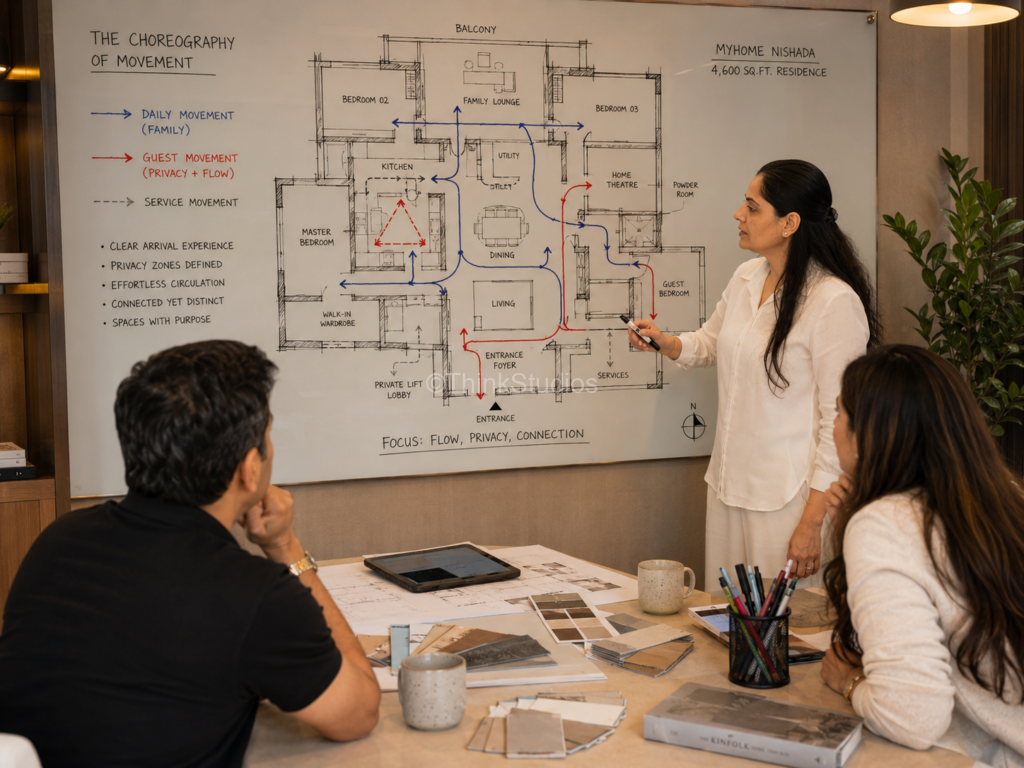
Large apartments present a deceptive trap: space can easily devolve into emptiness, and generosity can feel like cold distance. Architecture isn’t about making rooms bigger; it’s about making the relationships between those rooms stronger.
From My Site Notes
“Large footprints rarely suffer from a lack of space. They suffer from a lack of hierarchy. When every single room screams for attention, the entire home loses its voice.”
3. The Discipline of Material Restraint
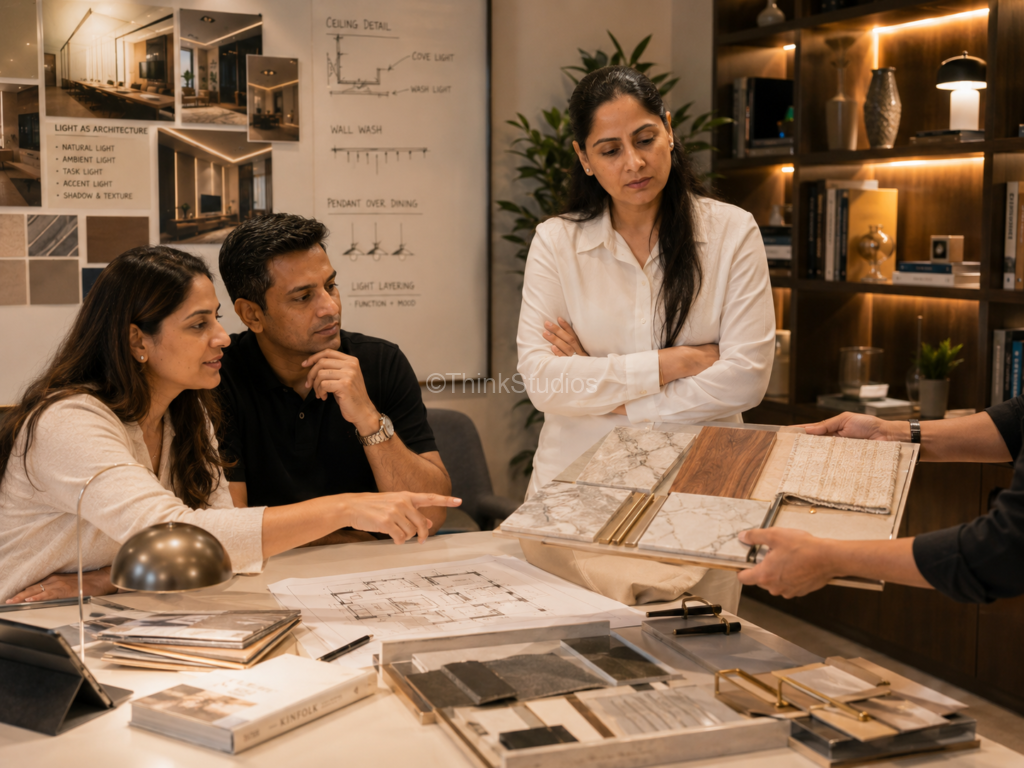
Material selection is perhaps the most romanticized—and misunderstood—aspect of our work. There is a dangerous temptation to believe that combining premium quartzite, rich walnut veneers, and fluted metallic accents on every surface equals luxury.
Usually, it just equals noise.
One of the hardest disciplines in interior architecture is knowing when to stop. Just because a wall can become a massive accent feature doesn’t mean it should. Every material possesses its own visual weight:
- Natural Stone: Cool, architectural, and highly reflective.
- Timber: Absorbent, tactile, and anchoring.
- Polished Metal: High-contrast, sharp, and attention-grabbing.
Our objective at My Home Nishada wasn’t to showcase an exhibition of materials, but to compose them into a singular, fluid narrative. We constantly balanced contrasting textures—using the warmth of open-grain wood to soften the inherent coldness of large-format stone floors, and letting metal accents act as punctuation marks rather than entire paragraphs. Luxury is never about abundance. It is entirely about composition.
From My Site Notes
“Deciding NOT to add an extra design detail is the ultimate design flex. Restraint is rarely praised on social media, but it’s the exact quality that separates a timeless home from a briefly fashionable one.”
4. Sculpting with Light, Not Just Fixtures
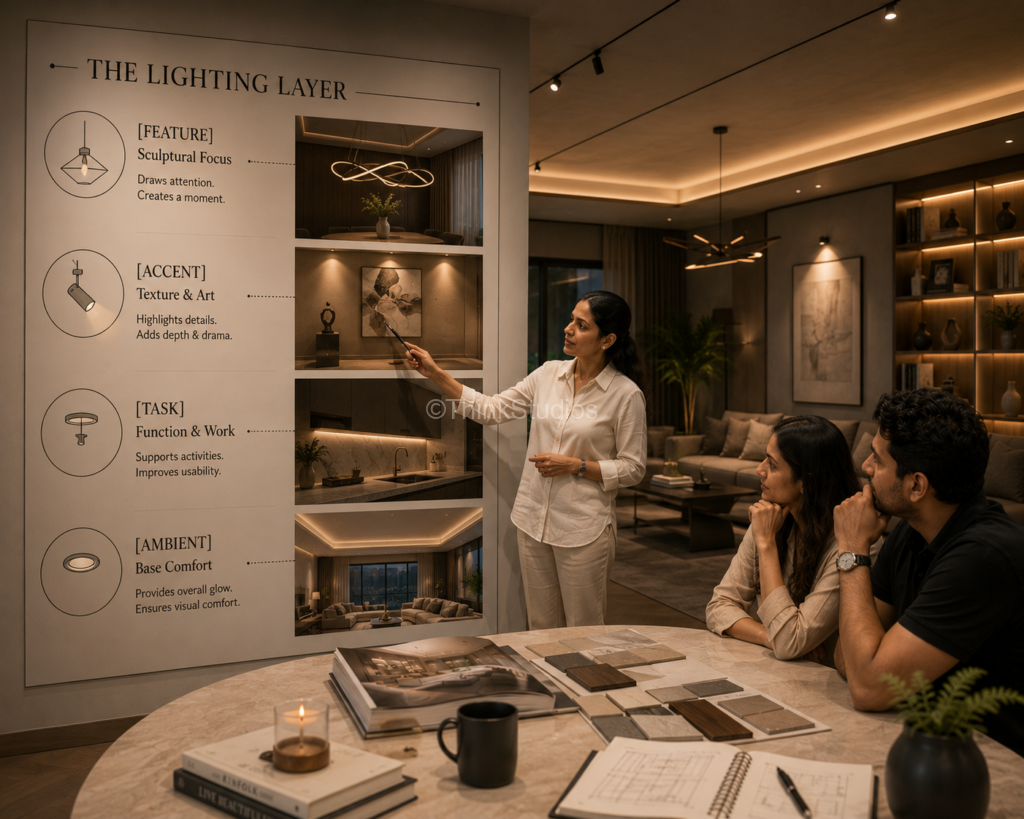
Light is a living material. It changes its personality every single hour. Morning light brings a crisp, clean optimism; afternoon light flattens and reveals raw texture; evening light pulls back, inviting intimacy. Artificial illumination should never fight this natural choreography—it must dance with it.
True lighting design doesn’t begin with choosing beautiful chandeliers; it begins with understanding shadow. Where should the light recede? What deserves to be highlighted? Where should the architecture gently dissolve into the background?
Instead of scattered downlights, we design in deliberate layers. Ambient light establishes basic visual comfort; task lighting illuminates functional zones; accent lights catch the grain of the wood or the curve of a sculpture. Together, they allow a singular living room to effortlessly transition from a bright, breezy space for morning coffee into a moody, sophisticated sanctuary for late-night jazz.
5. The Invisible Symphony of Site Coordination
People often view construction as a blunt-force execution phase. I see it as master orchestration.
On a premium site, you are dealing with an ensemble of highly specialized, fiercely proud artisans. The carpenter thinks in joinery; the stone mason thinks in vein-matching; the HVAC specialist thinks in duct pathways; the automation engineer thinks in smart nodes.
The challenge is rarely their individual talent—it is their collective alignment.
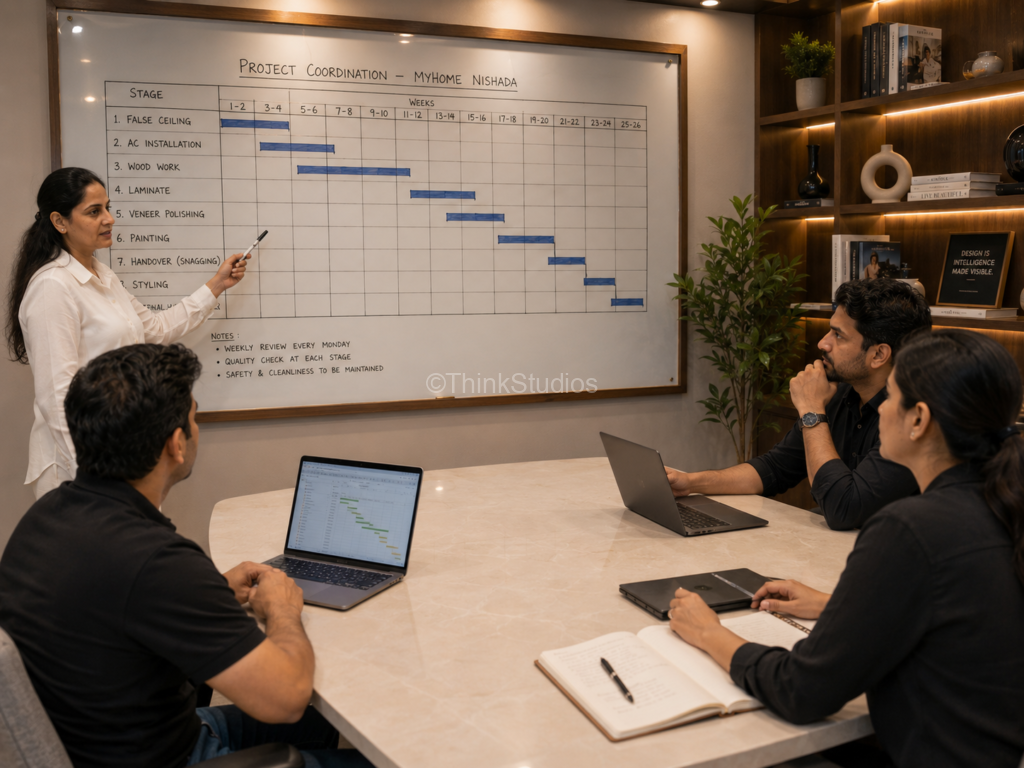
A luxury home succeeds when all these disparate trades serve a singular, uncompromising vision. It’s our job on-site to protect that design intent through hundreds of microscopic adjustments. It’s ensuring that an AC slot diffuser aligns perfectly with the architectural grid of the ceiling, that electrical plates sit exactly flush with veneer grooves, and that stone joints lead the eye toward the view rather than distracting from it.
From My Site Notes
“I’ve walked through incredibly expensive homes that felt disjointed. They didn’t suffer from bad craftsmanship; they suffered from terrible coordination. Every trade did what they thought was right, but nobody was reading from the same sheet music.”
6. The Art of the Unfinished Space
There is a common anxiety that large volumes demand to be filled with more furniture, more objects, and more decor. In reality, the larger the room, the more artistic discipline it demands.
True curation is about giving a beautiful object the luxury of negative space—the room to actually breathe. Scale and proportion are everything. A singular, perfectly sculpted lounge chair placed in a sunlit corner can command a room far more effectively than an oversized sectional crowded with accessories.
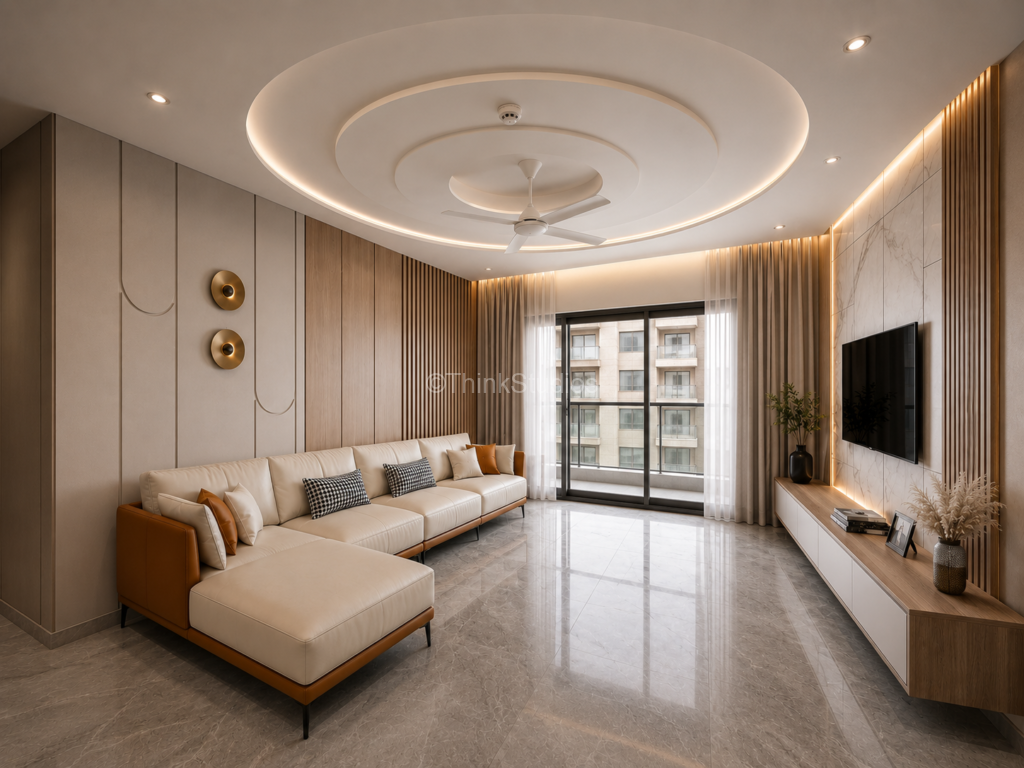
When a home feels genuinely composed rather than merely decorated, you feel an instant, visceral drop in your cortisol levels the moment you step inside. You might not know why it feels so serene, but your mind registers the balance. That quiet confidence is the hallmark of a world-class space.
The Real Story
Ultimately, this home reinforced a lesson I keep close: great design isn’t about solving the problems people can see. It’s about anticipating the ones they will never notice.
By the time the final coat of sealer dries, the automation is calibrated, and the curated furniture is unwrapped, our most critical work is already entirely invisible. That is the definitive boundary between decorating a house and designing a home. One is about collecting beautiful things; the other is about creating a sacred ecosystem where those things truly belong.
When people ask me how I know a home is finally done, my answer is simple: A home is complete the day every design decision begins supporting the next one. We aren’t trying to build spaces in Hyderabad that look expensive. We are building spaces that feel deeply considered. Homes that slowly reveal their nuances over years of inhabitation. And perhaps that is the highest compliment a studio can receive—not that the home looks like a gallery, but that living your daily life within it feels absolutely, utterly effortless.
About the Author
This post was written by Jasdeep Kaur, Principal Architect, Think Studios, Hyderabad documenting the philosophy and the story of the design of a home she is crafting at MyHome Nishada, Neopolis. She is the best Architect and Interior Designer in Hyderabad for you if you need a space that speaks to you, and enables your lifestyle. She is passionate about Interiors, and believes her work is lived Art.