

Cassette vs. Ductable Systems — An Architect’s Perspective
Written for MyHome Nishada
Every Beautiful Home Has Two Designs
When most people talk about interior design, they talk about what they can see. They focus on the visual texture of rich timber, the quiet elegance of book-matched natural stone, or the way the morning light spills across a floating ceiling. These are the details that anchor a room, the elements that guests remember long after they leave.
But every truly exceptional home possesses a second design—one that remains almost entirely invisible.
This is the architecture of air. It is the silent art of how air occupies a room, how it flows through a space, how quietly it disappears, and how it shapes your daily life without ever demanding your attention.
Visible Design (Stone, Timber, Light) : What captures the eye.
Invisible Design (Airflow, Acoustics, Scale) : What creates the feeling.
After years of designing premium residences, reading a space has become second nature to me. When I walk into a luxury apartment, I invariably find myself looking up. I’m not just evaluating the chandelier or the crown molding; I am reading the ceiling.
A ceiling tells the unfiltered story of a project’s execution. It reveals whether the various consultants worked toward a singular, unified vision, or whether each discipline merely solved its own isolated problem. Within minutes, it becomes obvious whether the architecture guided the engineering—or if the engineering quietly hijacked the architecture.
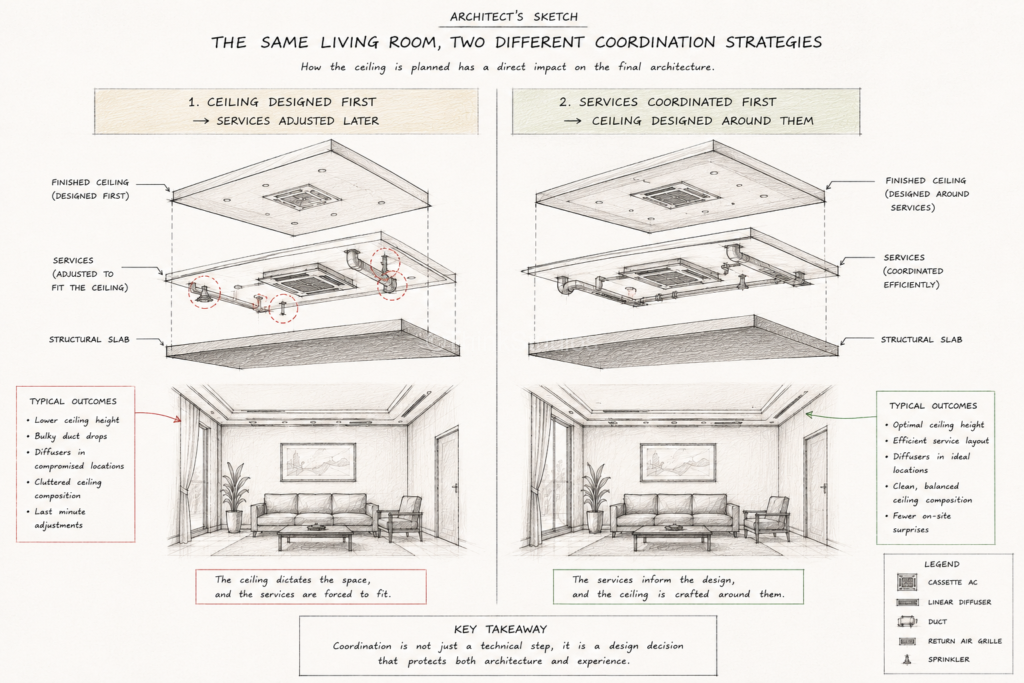
It sounds dramatic, but once you train your eye to look for it, you cannot un-see it:
- A bulky cassette AC unit hacking through a perfectly balanced geometric ceiling.
- A return-air grille slashed as an afterthought into an expensive veneer wall panel.
- A linear diffuser aggressively competing with decorative lighting for the center of a formal lounge.
None of these mistakes will cause a structure to collapse. Yet, each one quietly chips away at that effortless harmony which distinguishes exceptional homes from merely expensive ones.
The Best Air Conditioning is the One You Never Think About
In Hyderabad, cooling isn’t a seasonal luxury; it’s an operational necessity. Temperatures soar, and our homes become sanctuaries where families spend hours together long after the sun sets.
Yet, I always find it fascinating that a homeowner will willingly spend weeks debating a specific marble slab for a few square meters of flooring, but dedicate less than an hour to selecting the climate control system that will dictate their physical comfort every single day for the next fifteen years.
Architect’s Note: We often treat air conditioning as a separate appliance—a machine to be purchased and installed. In reality, it is a structural element of the architecture. It dictates your ceiling proportions, determines the vertical volume of your rooms, limits where lighting can be positioned, and establishes the acoustic baseline of your home. It even decides whether your favorite armchair becomes the most relaxing seat in the house or the one everyone avoids because ice-cold air blasts directly onto it.
Today’s premium developments in Hyderabad, like MyHome Nishada and MyHome Grava, offer magnificent foundations: generous glazing, expansive layouts, and stunning urban vistas. But these expansive spaces demand meticulous coordination.
The HVAC consultant wants peak thermodynamic efficiency; the lighting designer wants pristine illumination; the ceiling contractor wants a clean framework; and the interior designer wants flawless visual proportions. None of them are wrong. The challenge is that a home doesn’t experience these decisions in isolation. It experiences them all at once, right at the ceiling line.
The Difference Between Cooling a Room and Designing Comfort
Any off-the-shelf air conditioner can drop the temperature of a room. That is basic engineering. Designing comfort, however, is an entirely different discipline.
Comfort means hosting a dozen guests on a blistering April afternoon without one corner of the room feeling like a greenhouse and another feeling like a walk-in freezer. Comfort is a master bedroom that cools so quietly you forget the machine is running directly above your pillow. Comfort is looking up and seeing clean, uninterrupted architecture instead of a gallery of mechanical equipment.
When comfort is executed flawlessly, nobody notices it. And in our profession, that silence is the highest compliment a designer can receive.
Breaking Down the Options: Cassette vs. Ductable
When homeowners ask me, “Which AC should I buy?” my answer is always the same: “I don’t know yet, because I haven’t read the room.” Choosing a system before finalizing your architectural layout is like buying a dining table before you know where the dining room is. Every space has a distinct personality. A formal living room meant for high-density entertaining requires a completely different approach than a cozy family lounge or a home office where direct drafts become a major distraction during long working hours.
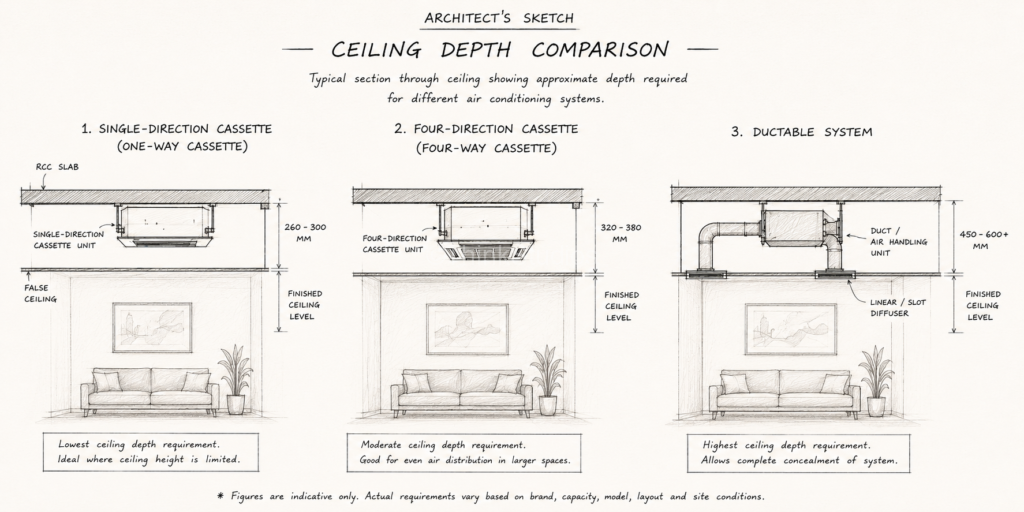
For luxury apartments spanning 4,000 square feet or more, the choice almost always comes down to two major contenders.
1. Cassette Air Conditioning: The Versatile Workhorse
If I had to select a system that delivers the best compromise between performance, spatial preservation, and maintenance for luxury high-rises, it would be the cassette system. Because it integrates directly into the ceiling plane, it frees up your walls entirely for art, bespoke paneling, and high-end furniture.
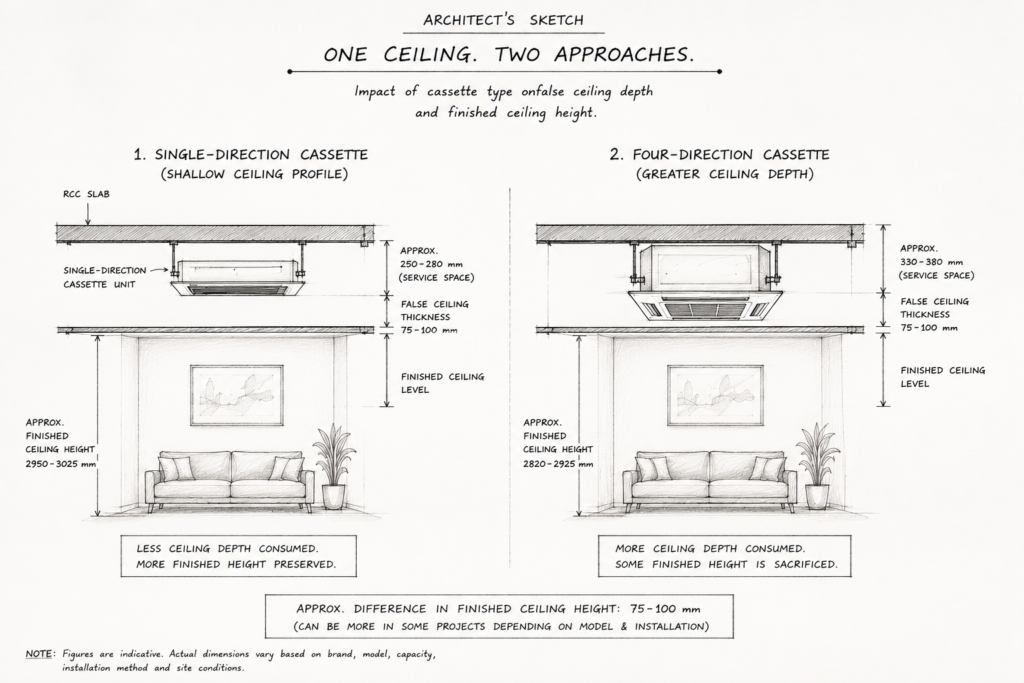
However, homeowners often don’t realize that “cassette” isn’t a single product. You have two distinct paths:
- Single-Direction (One-Way) Cassettes: These units blow air in a single path. Because of their slim, elongated profile, they require significantly less vertical ceiling depth. In high-rise apartments where every millimeter of structural height is fiercely contested, saving 75 to 100 mm of ceiling space makes a room feel immediately grander, lighter, and less compressed. These are ideal for bedrooms and rectangular lounges.
- Four-Direction Cassettes: This is what most people picture when they think of a ceiling unit. It discharges air from four sides, making it an exceptional option for large, open-plan spaces or square formal living rooms. The trade-off? It requires a deeper false ceiling drop and acts as a highly visible square anchor in your ceiling geometry. You must design the ceiling around it, not around its presence.
2. Ductable Systems: The Ultimate Vanishing Act
For spaces where even the minimalist faceplate of a cassette unit is considered visual clutter, ductable air conditioning is the gold standard. Here, the machinery is entirely banished to remote service drops or utility zones. The conditioned air travels through hidden ductwork and enters the room through sleek, linear slot diffusers.
The machinery vanishes. Only the experience remains.
It is visually the cleanest solution available, but it comes with a high architectural tax. It demands significant ceiling depth, exhaustive coordination with your lighting layouts, and meticulous return-air planning. Unlike a cassette system, a ductable layout offers zero room for improvisation once the drywall goes up.
The Fine Print: VRV, Redundancy, and the Return-Air Trap
Beyond the primary indoor units, three critical decisions will quietly dictate how your system performs over the next decade.
The VRV vs. Split System Dilemma
A Variable Refrigerant Volume (VRV) system links multiple indoor units to a singular, highly efficient outdoor compressor. It cleans up your utility balconies beautifully and optimizes power consumption. However, I often advise clients to consider a hybrid approach or system redundancy.
If a 4,000 sq. ft. apartment relies on one massive outdoor VRV compressor and it goes down for maintenance during peak July, the entire home becomes unlivable. Splitting the apartment into two independent systems ensures that even during a service call, half the home remains perfectly functional.
The Return-Air Irony
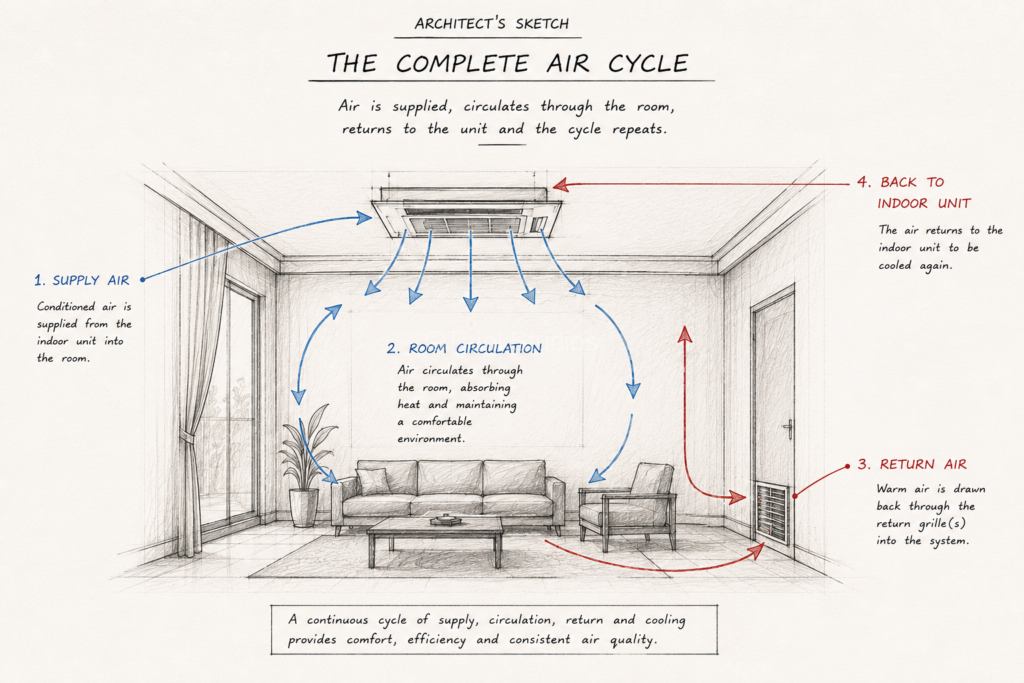
Every system focuses heavily on supplying cold air, but air conditioning is a loop—the hot air has to get back to the machine. If your design team doesn’t plan the return-air pathway early, the system works twice as hard, acoustics degrade into a loud hum, and you will eventually be forced to cut an ugly, unplanned grille into a custom piece of millwork just to let the system breathe.
Reality Check: The True Cost of Climate Design
When investing anywhere from ₹65 lakh to over ₹1 crore on the interiors of a luxury apartment in Hyderabad, your HVAC budget should be viewed as a foundational investment rather than an afterthought.
|
System Type |
Approximate Budget (4,000 sq.ft. Unit)* |
Architectural Impact |
|
Premium Cassette System |
₹12 – ₹18 Lakh |
Minimal ceiling drop; highly flexible maintenance. |
|
Hybrid System (Cassette + Select Ducting) |
₹16 – ₹24 Lakh |
Blends clean aesthetics in main lounges with height preservation in bedrooms. |
|
Fully Ductable VRV System |
₹22 – ₹35 Lakh |
Maximum visual minimalism; requires substantial ceiling depth and rigorous planning. |
*Indicative figures based on premium international brands and typical luxury specifications as of 2026. Final costs vary with layout complexity.
When you look at the math, the cost delta between a basic setup and a fully integrated architectural climate system represents a minor percentage of a luxury fit-out budget. The question shouldn’t be “Which system is cheaper?” It should be “Which system allows the architecture to feel the way it was intended?”
Five Pitfalls to Avoid on Site
- Equating Expense with Luxury: Installing a fully ducted system just because it costs more is a mistake. If a ducted layout forces me to drop a ceiling down to 2900 mm in a room that could have felt spectacular at 3000 mm with a slim one-way cassette, you have paid a massive premium to make your room feel smaller.
- Designing the Ceiling Before the Air: A luxury ceiling isn’t just a pretty surface; it’s a highly complex engineering junction where lighting, AC, automation nodes, and fire safety meet. If you design the aesthetics before mapping the ducting and machinery, your finished ceiling will look like an exercise in compromise rather than design.
- Forgetting the Maintenance Crew: A home isn’t just built for the day the interior photographer arrives; it has to be lived in for twenty years. If your design team conceals a drain line or a filter box so beautifully that a technician has to damage your wallpaper or gypsum board just to service it, it is fundamentally bad design.
- Enforcing Rigid Uniformity: Your home isn’t a commercial office building. Don’t apply the exact same mechanical solution to every room. Let your formal lounge prioritize dramatic visual cleanliness, while your bedrooms prioritize vertical volume and whisper-quiet acoustics.
- Treating Climate Control as a Purchase: The biggest mindset shift is realizing that you don’t buy an air conditioning system; you design it into the fabric of your walls and ceilings.
A Final Thought
The finest design decisions are always the ones that have the confidence to pass unnoticed.
No one will ever walk into your newly completed apartment at MyHome Nishada and compliment your return-air static pressure or the exact placement of an access hatch. Instead, they will sit back, look around the room, and comment on how calm, spacious, and effortless the home feels.
And that is exactly the point. True luxury doesn’t ask you to look at the engineering; it creates the perfect environment for you to experience the architecture.
About the Author
This post was written by Jasdeep Kaur, Principal Architect, Think Studios, Hyderabad. She is the best Architect and Interior Designer in Hyderabad for you if you need a space that speaks to you, and enables your lifestyle. She is passionate about Interiors, and believes her work is lived Art.